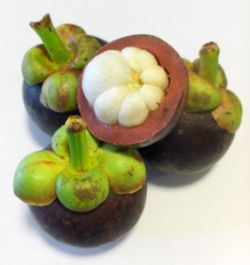
 During my frequent trips to south-east Asia, I always enjoy a very peculiar, tropical fruit – mangosteen. It is one of the most praised of tropical fruits, and certainly the most esteemed fruit in the family Guttifera. The fruit is round and about 1.5 -2″ in diameter with a very dark purple smooth skin. It is better to open it with a knife by cutting around the middle completely through the rind, and lifting off the top half, which leaves the snow-white, juicy, soft segments exposed in the colorful “cup”â??the bottom half of the rind. The fruit is exquisitely luscious and delicious, and it is by far my most favorite taste of all.
The rind of partially ripe fruits yields a polyhydroxy-xanthone also called Ã?-mangostin; whereas, fully ripe fruits contains the xanthones and various derivatives. Xanthones are unique chemical compounds composed of a tricyclic aromatic system with a variety of phenolic, methoxy, and isoprene substituents, giving rise to numerous derivatives. They dissolve to varying degrees in solvents ranging from alcohol to hexane.
Scientist at Weber State University developed methods for extraction, identification and quantitation of xanthones and their derivatives: alpha-mangostin, 8-desoxygartanin, gartanin, beta-mangostin, 3-mangostin, and 9-hydroxycalabaxanthone. They found that the optimum solvent mixture of acetone/water (80:20) selectively and effectively extracts a wide variety of xanthones and subsequent [tag]HPLC[/tag] analysis using standard C 18 Reverse Phase column and a 30-min gradient of 65-90% methanol in 0.1% formic acid detects and separates numerous different xanthones with UV detection at 254 nm.
11 Responses to “HPLC analysis of xanthones in mangosteen fruit”
Leave a Reply
Tag Cloud
-
adsorbent
benzene
china
chlorophyll
chromatographic
chromatography
column chromatography
CZE
DESI
electromagnetic induction
electrospray
ELISA
eluent
explosives
forensic
furosine
Gas Chromatography
GC/MS
History
HPLC
IC
isoflavones
lab-on-a-chip
LCMS
maldi tof
Mass Spectrometry
microfluidic
nano
Nano HPLC
nanoliquid
nanoscale
nanostream
nanotechnology
nanotubes
News
organic molecule
protein
Rickettsia
rmsf
rocky mountain spotted fever
science
soy
TCM
ticks
tsvet




HI, im very intersted in analysis of mangosteen extract with HPLC. But i want the mobile phase is methanol: water. is it possible??
thanks.
maybe we can, communicate with email.
wijaya_aw13@yahoo.com
Thank you befroe
hi. why do you consider acetone:water (80:20) as the best solvent for mangosteen periicarp extraction? why is it better than ethanol? we are planning to test the pericarp’s extract against a certain bacteria, how can we purify further the extract? we dont have plans to use chromatography in this experiment. thank you
can you really extract xanthone from the bark of the Mangosteen fruit?
Excellent information! Thanks for putting so much time and effort into your blog. Have a look at my XanGo site.
i wanna ask..
how to extract the pericarp of mangosteen?
what kind of solvent must i’m use?a
s i know that the pericarp contain enzyme,what kind of enzyme it is?
what method must i use to extract the pricarp to get the enzyme?
hope do reply me a.s.a.p
we are having some research for this topic..we need mor some info about this.can you help us?
My final year project is almost similar with your title here…extraction of xanthone and analyze using GC-MS….not HPLC…i wan to ask u some questions:
!) can it be using GC-MS to analyze xanthone?
2) May i know what is the extraction process and crude ectract process? includes the solvents and methods.
3) what is the m/z ratio of xanthone in MS?
4) The extraction method of xanthone for another fruit is it similar to mangosteen?
Fruits and berries offer tremendous health enhancing qualities and contain hundreds of naturally occurring vitamins, minerals, antioxidants, amino acids, enzymes, essential fatty acids, fiber & phytonutrients. The 4 â??Super Fruitsâ? contained in Chews-4-Health are considered by many experts to be the most nutrient rich fruits the world has to offer. Our carefully selected super-fruit complex gives you the power of all 4 in one supplement.
in the absence of HPLC how can i isolate and extract xnathone, even though crude xanthone only.
I’m very interested in your HPLC analysis of xanthone in mangosteen. Can I ask you some questions?
1. What is the extraction process and crude ectract process? includes the solvents and methods.
2. what is the purification process?
3. What types of adsorbent you are using?
What is the suitable adsorbent for purificanion of phenolic compounds in mangosteen?
4. What is the mobile phase you are using? and the sequence of solvent being used?
5. What is the physical indicator to justify that elution proces is completed?
6. Im your opinion, what is the suitable type of elution solvent commonly used ?
7. normally, eluants are in mass or volume form?\
Hope to hear from you soon. Thank you for you attention. you can directly reply to my e-mail icexxm@hotmail.com.
I’ve seen this fruit in market when I was in Thailand but never got around to try it. Now after your review I might have to next time I go.